
.svg)


In every business, sales and operations play vital roles, but their functions are very different. Sales teams bring in revenue by securing customers and closing deals, while operations teams ensure that what was promised actually gets delivered efficiently and consistently.
When these two functions are out of sync, the results can be painful. Misalignment between sales and operations doesn’t just cause frustration; broken operations kill growth by creating bottlenecks that slow delivery, hurt profitability, and erode customer trust.
This post explains the core differences between sales and operations, explores how misalignment creates growth bottlenecks, and offers practical guidance to eliminate these barriers so your business can scale effectively.
What Are Sales?
Sales is the engine that drives revenue in an organization. The sales team interacts directly with prospective customers, understands their needs, explains the value of products or services, and negotiates agreements. Sales professionals focus on identifying opportunities, managing relationships, and closing deals.
Their metrics often include conversion rates, revenue targets, sales cycle length, and customer acquisition. In many companies, sales are seen as the growth driver because without new customers and deals, the business cannot increase its market share or revenue.
However, sales can only be effective if the rest of the organization supports the promises sales make. For example, a sales team might commit to fast delivery or specific product configurations, but if operations cannot meet these commitments, the customer experience suffers. This is why alignment between sales and operations isn’t a luxury; it’s a necessity.
What Are Operations?
Operations covers all the processes that take an order from concept to fulfillment. This includes production planning, inventory management, logistics, quality control, and customer support.
Where sales focuses on winning business, operations focuses on fulfilling that business efficiently, consistently, and profitably. Operational teams strive to balance capacity with demand, maintain quality standards, and optimize internal workflows.
Effective operations make sure that what was sold can actually be delivered on time, within budget, and without consuming more resources than planned. In simple terms, operations turn sales promises into reality.
When operations function well, they provide consistency, reduce waste, and support long-term scalability.
Key Differences Between Sales and Operations
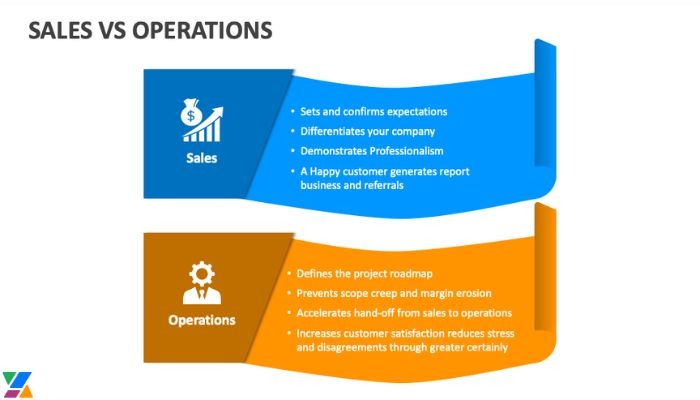
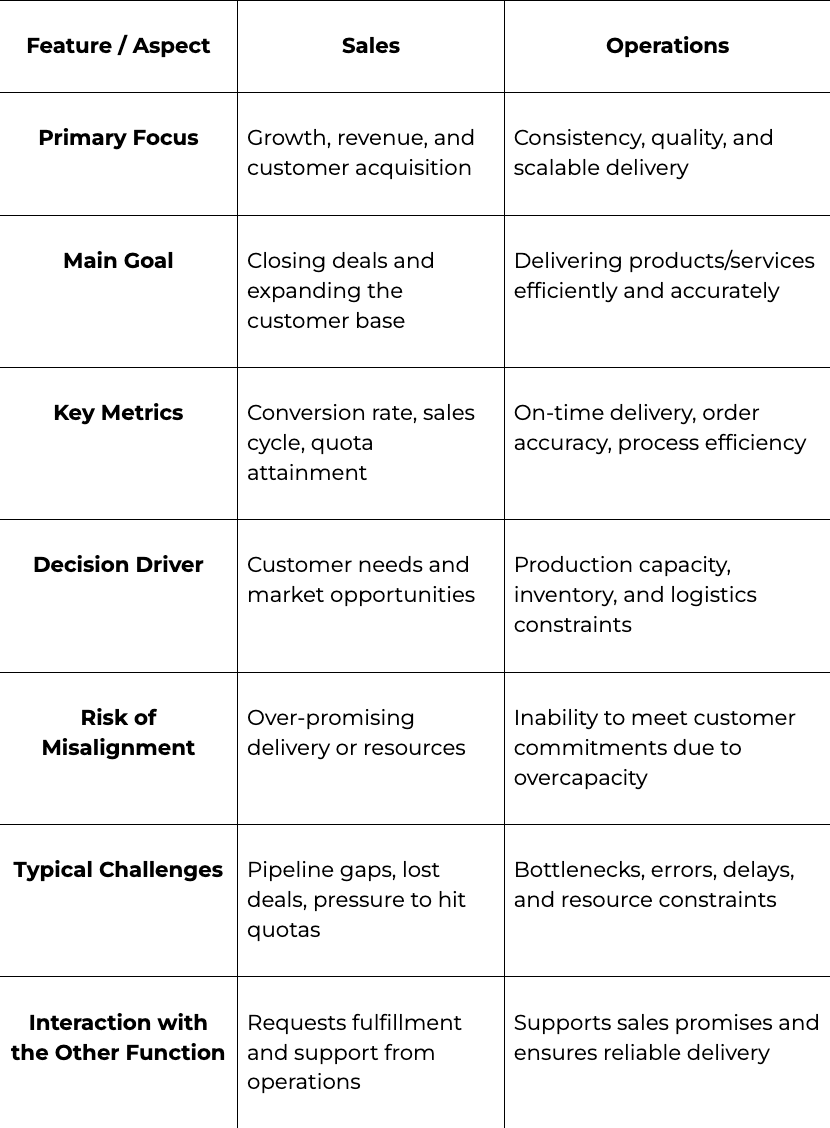
Sales and operations differ in their priorities, objectives, and daily activities.
How Broken Operations Kill Growth
When sales and operations don’t work together, several damage points emerge:
1. Missed Deadlines and Delays
Sales may commit to tight delivery windows that operations cannot realistically meet. This results in late shipments and damaged trust.
2. Inventory Imbalances
Without cooperation between sales forecasts and operational planning, inventory levels can swing between overstock and stockouts—both costing money. Poor forecasting and a lack of shared data breed inefficiency.
3. Reduced Customer Retention
Inconsistent delivery and broken promises reduce customer satisfaction and repeat business. Companies with aligned teams see higher retention because expectations and delivery are synchronized.
4. Revenue Loss from Misalignment
Misalignment between sales and other departments, including operations, can cost businesses more than 10% of annual revenue due to inefficiencies and dropped opportunities.
The Value of Alignment:
Bringing sales and operations into alignment isn’t just good teamwork—it’s measurable business value. Here’s what strong alignment does for companies:
- Faster Revenue Growth – Aligned teams can grow revenue faster, often at rates 20–27% higher than misaligned peers.
- Higher Win Rates and Retention – Organizations with coordinated teams report significantly higher win rates and better customer retention than those with siloed departments.
- Better Forecast Accuracy – When operations plans are informed by real sales forecasts, planning becomes more accurate and less wasteful.
- Improved Efficiency Across the Board – Shared goals reduce redundant work and promote smarter resource use.
Bridging the Gap Between Sales and Operations
To eliminate growth bottlenecks, teams must move beyond siloed thinking. Here are proven strategies:
1. Align Goals and KPIs
Both teams should share clear performance metrics. For example, customer satisfaction or on‑time delivery targets benefit both sales and operations. A shared incentive structure encourages collaboration instead of competition.
2. Improve Cross‑Functional Communication
Regular inter‑team meetings, shared dashboards, and integrated planning tools create transparency so everyone understands capacity, forecasts, and constraints.
3. Incorporate Sales & Operations Planning (S&OP)
S&OP is a process that aligns forecasts with capacity planning, inventory strategy, and resource allocation. It ensures teams work from the same assumptions and can anticipate constraints before they become crises.
4. Adopt Unified Platforms
Using shared technology—like integrated CRM and ERP systems—ensures data flows freely between sales and operations. This reduces errors and provides real‑time visibility for better decisions.
Actionable Steps to Avoid Growth Bottlenecks

If you’re experiencing gaps between sales and operations, here’s a clear action plan:
- Map Your Processes – Document sales handoffs, operational triggers, and decision points.
- Identify Bottlenecks – Use data to pinpoint where delays or errors occur most often.
- Set Shared Goals – Define KPIs that matter to both teams, like delivery accuracy and forecast reliability.
- Implement S&OP and RevOps Practices – Roll out structured planning and coordinated revenue operations.
- Review and Adjust Regularly – Continuous improvement prevents old patterns from resurfacing.
Conclusion:
Sales and operations each play unique roles in business success. Sales brings demand and revenue growth, while operations delivers that promise efficiently and reliably. But without alignment, even powerful sales efforts can hit growth bottlenecks that stall progress.
Ready to identify your bottlenecks and optimize for growth? Start with a comprehensive process review and align your teams around shared goals today.